
This is a somewhat mathy post, which may nevertheless be helpful to some.
Star Trek Adventures is a table-top roleplaying game (“ttrpg”) published by Modiphius, using their 2d20 system. (Which Modiphius uses in adapted forms for their many other products, too.)
I have many ambivalent feelings about ST:A and 2d20. Some of its design choices are good, some bad, some what could be called situational. However, this is not the time nor the place for an in-depth review of the system. In this post, we look at the 2d20 dice mechanics and probabilities.
What is 2d20, anyway?
(If you know, you can skip to “Results” below.)
One of the reasons why I personally think d100 percentile systems (any roll-a-single-die systems, really) are superior to the 2d20 family is that they are relatively easy to think about. Probabilities of a single dice roll are as per discrete uniform distribution, and rolling once with objective of rolling against the target number has easy-to-determine probability of success (in percentile system, the target is to roll under a percentile from 0 to 99 describing a character’s skill in a standard difficulty task). Roll-above single die systems like DnD are also fairly simple to think about. There are many things not to like about DnD, but if the game master (GM) has revealed a target number (DC), it’s not that difficult to figure out what is the probability of your character succeeding. (It is determined by whether a result of single 20-sided die roll plus a fixed modifier is at or above the DC.) . I believe these sorts of legible probabilities simply life of the GM and the player alike.
Modiphius’ 2d20 system is a roll-under mechanism with dice pool characteristics: in order to determine if their character succeeds at a difficult or perilous task, the player rolls two (or more) d20-sided dice, and wants to obtain on each die a result that is equal or less than a target number. Each dice under the limit is a success. More successes, better the result. The target number is a sum of player character’s most relevant attribute and discipline to the task (attribute + discipline). A roll of exactly 1 on face is a critical success, worth two regular successes. If your character has a relevant Focus, any roll equal or under the discipline number is a critical success, too. So by default, rolling two dice can result in 0, 1, 2, 3 or 4 successes. Each task has a set difficulty, which is a number of successes required to complete the task. Easy tasks require only a single success, very difficult 5 successes, normal difficulty tasks usually 2 tasks.
In addition to the basic mechanic described above, one character may help another: they are allowed to roll a single d20. Any successes the assisting character obtains are added to main acting character’s roll. Most importantly, the player characters have a shared narrative resource called Momentum, which they gain in various ways: by spending Momentum points, you may buy extra dice. (With 1-point Momentum spend, you get to roll 3d20 instead of 2d20, additional 2-point Momentum spend on top of that grants you another d20 (4d20 total), up to 3-point spend granting maximum of 5d20). Momentum can be used in various other ways and there are other ways of getting extra dice, but this is the main mechanic.
For example, if my highly decorated Klingon science officer Kargan scans a unknown scientific anomaly with his tricorder, I roll 2d20. Kargan’s relevant Attribute in the task is Reason, maxed out at 12, and Discipline is Science, also maxed out at 5, resulting in total target number 17. If I were rolling a single d20, the probability of success is nice and easy to compute, 17/20 = 85%, a quantity many players can calculate mentally. But I am rolling two d20s independently: number of regular successes is a probability of success in two independent trials with 85% probability of success each. I am confident that most people don’t remember binomial probability formula by heart, and while I do, it’s even rarer to be able to compute it quickly mentally. (For exactly two successes out of two rolls, that’s 0.85 times 0.85, or . Here I admit I have computed it sufficiently many times during Kargan’s 5-year campaign that today I remember the probability is 0.7 plus something, but if I didn’t remember or wanted an exact answer, I would reach for a calculator (which is not quick, either, but will give me the result of 0.7225, or 72.25%). Even better for Kargan (and worse for the player who wishes to know Kargan’s success odds), Kargan has gained a Focus in Sensor Data Analysis, if either dice as a result from 1 to 5 will generate 2 successes, not 1.
So lo and behold, I got frustrated enough that I wrote a small script in R and made nice plots of all possible results.
Results, 2d20
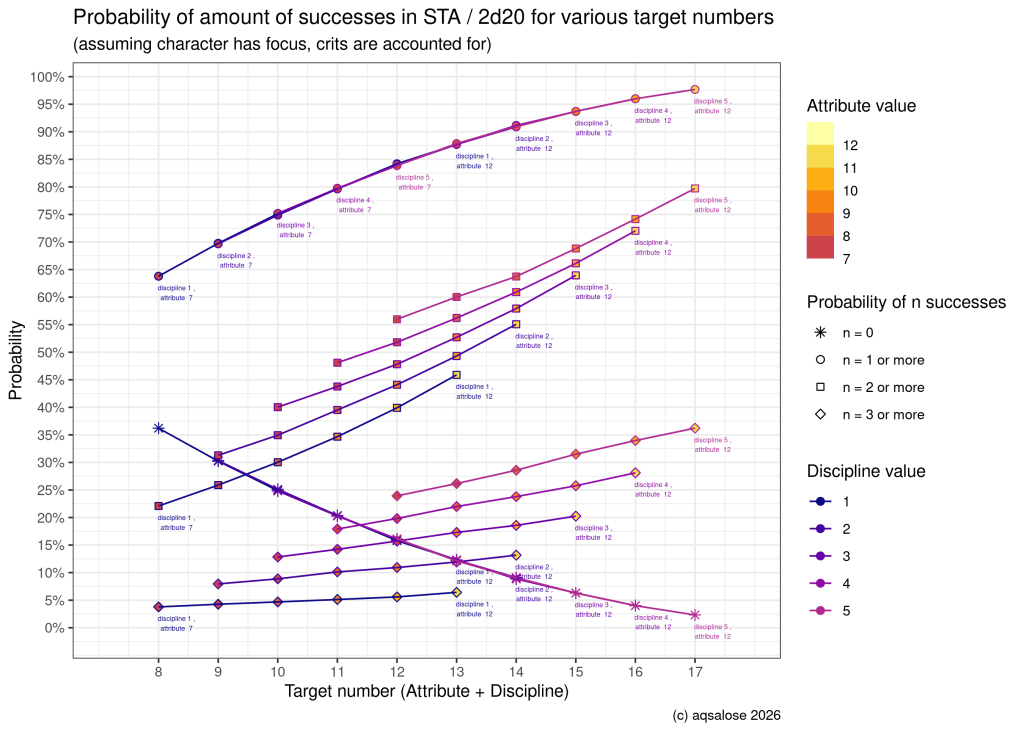
Here is the first figure, probability of 0 success, and 1 or more to 3 or more successes in 2d20, accounting for critical successes under focus.
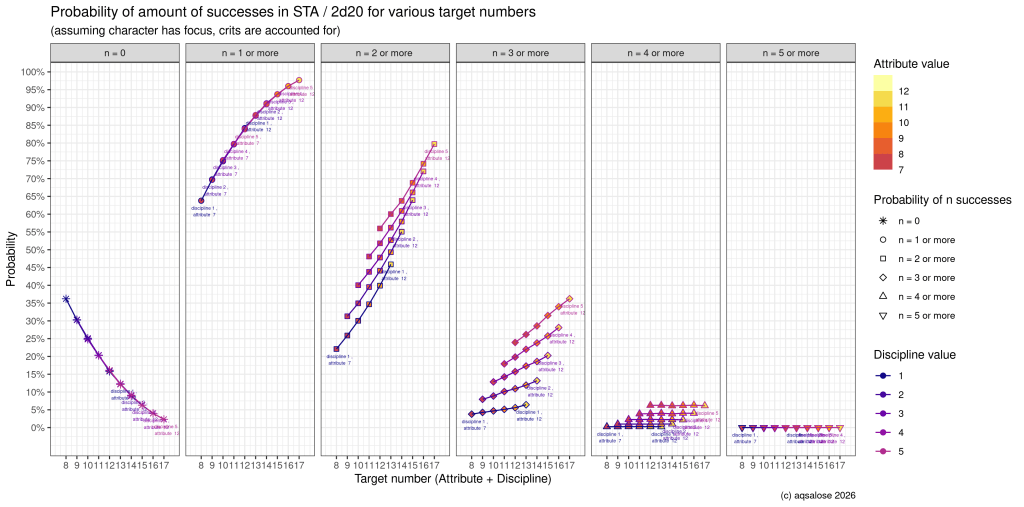
In case that is hard to read, here is a plot where each difficulty (n successes) has its own faceted graph. I also had now more space to add n 4 and 5 (where 5 obviously is 0 when rolling 2 dice without assistance, but it’s useful later when we add comparisons with Momentum spends).
Technical digression: I don’t know if this style of plot has a name: initially I started by calculating the results and simply plotting probability of each one as a point, where on X-axis you have target number (attribute + discipline value sum) and on Y-axis the probability of the result. Because that was difficult to read, I added some shapes and colors and connecting lines.
Shapes denote number of successes (in practice, difficulty levels: 2 or more is needed to succeed at difficulty 2 tasks, and so on). Interior color denotes attribute value and outer color discipline value. (Different combinations of attribute and discipline values can yield same target number, but with a focus, different combinations have different probabilities to crit despite same target number.) Decision to connect same “discipline levels” rather than “attribute levels” is arbitrary, except for producing prettier result as color of both shapes and lines connecting them match (after I chose Discipline rather than Attribute as outer color).
Results are inexact from simulation, which causes small jitter.
Commentary
I don’t know if there is anything too surprising about any of this to experienced 2d20 players: it is commonly known that higher discipline + focus is more valuable than an attribute increase. I was slightly surprised by the exact scale of the crit benefit. At target number 12, low attribute but high discipline (A7+D5 and A8+D4) carry you to 50+% probability of success territory at difficulty 2. A11+D1 is approx 15 percentage points less valuable than A7+D5, “despite” same target number. It’s not that much, but succeeding slightly more often than failing rather failing slightly more often than succeeding is one of those things that intuitively feel like a lot in an extended campaign.
Looking it other way, if you started with combination of A7+D1 in some task of importance (success probability approx 23%), and you wanted (for some reason) increase that particular task performance in your next level-ups (milestones), you might consider while to using your milestones for one focus and 4 discipline increases, bringing you to A7+D5=12 and approx 55% success probability, rather than get 5 attribute increases, bringing you to A12+D1=13 and approx 46% success probability.

